Create Your First Project
Start adding your projects to your portfolio. Click on "Manage Projects" to get started


University of Pittsburgh: Senior Design Project
Project Type
Capstone Academic Project
Location
University of Pittsburgh - Pittsburgh, Pennsylvania
Project Timeline
August 2025 - May 2026
Role
Managing Editor, Subgroup Member - Circuits Team
As a capstone experience to finish my time in the University of Pittsburgh's undergraduate Bioengineering program, I am currently taking the two-semester Senior Design course sequence. My role in our design team is the Managing Editor, ensuring that all DHF (design history file) documentation of our project is professional and FDA-compliant. Additionally, I am a member of the team's circuits subgroup, helping to lead prototyping for the electronic aspects of our proposed device.
During the the beginning stages of this project, my team focused our efforts on ethnography—reaching out to clinicians to discover unmet clinical needs in various areas of medicine. As a result, clinicians in the rehabilitation field brought to our attention that amputees frequently experience pressure injuries due to improper prosthetic fit.
In cases of neuropathy, or nerve damage resulting in lack of sensation, amputees may not be able to identify when pressure on their residual limb is causing injury. Current solutions to this problem are often qualitative, relying on visual inspection or the patient's ability to indicate pain. The central aim of our work is to provide clinicians with informative and quantitative pressure data, optimizing their workflow by simplifying the prosthetic adjustment process, and providing patients with better outcomes.
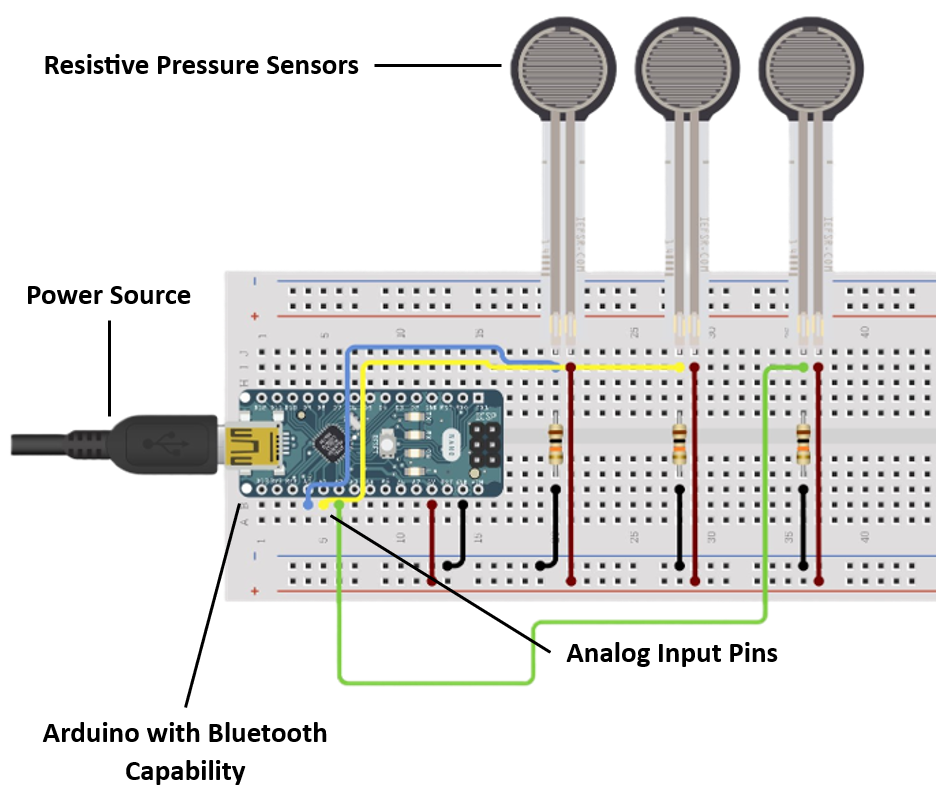
My team conducted Killer Experiments to test the feasibility of our design concepts, ultimately settling on a pressure sensing system combination of a specially-designed prosthetic sock, a microcontroller-and-circuit interface to wirelessly transmit pressure data via Bluetooth, and a Python-coded GUI.
Entering the second semester, I focused on refining the electronic subassembly of our device. Our first-semester prototype relied on a simple voltage divider design for proof of concept, but produced a nonlinear output, which would complicate calibration. I prototyped several operational amplifier circuit configurations to linearize and condition input signals, and worked as a key developer of our team's sensor calibration SOP, fitting equations to sensor outputs when loaded with 0, 10, 50, 100, and 120% of the maximum clinically expected load.
During initial calibration sessions, I identified persistent cross-talk between sensor signals, and spent considerable time troubleshooting the root cause. I traced the issue to the op-amp, which was poorly suited for a low-power, battery-operated device. With some research, I was able to source an appropriate replacement and recommend it for purchase. After the new component entirely eliminated cross-talk, we recalibrated our pressure sensors and proceeded to formal verification and validation testing.
I independently authored two engineering verification test protocols and their corresponding reports: a battery endurance test and a sensor calibration accuracy test. The device met the acceptance criteria of both tests. The device is capable of sustained operation on a rechargeable 9V battery well beyond our specified 30 minutes of continuous use, and sensor reading fell within our team's acceptable tolerance of ±1 lb or 10% of the applied load. Images of these verification tests can be seen in the gallery below, along with a description if the image is hovered over.
In addition to verification, our team conducted validation testing in clinical environments with prosthetists and transtibial amputees, receiving positive feedback. Our team also filed a provisional U.S. patent application for the device, a meaningful marker of how far our project has come.